




|
|
|
|
An “immigration checkpoint” for viral entry and how influenza outsmarts it
(DOI: https://doi.org/10.1038/s44319-026-00942-x)
|
|
Viruses are master manipulators which hijack cellular machinery to invade host cells, replicate, and release their progeny virions into the environment. This study, published in EMBO Reports by Gupta et al., reveals a previously unrecognized mechanism by which influenza virus gains entry into its target cells and bypasses the checkpoints that restrict it. The study finds that the WASH complex, which regulates endosomal actin dynamics, facilitates viral internalization in non-canonical manner. Intriguingly, while the WASH complex supports viral entry, its own FAM21 subunit acts as a molecular brake by linking WASH to the retromer subunit VPS35, thereby restraining its pro-endocytic activity. The host protein TRIM62 releases this brake by disrupting the WASH-retromer association, enabling WASH to function in a retromer-free state that favours productive viral entry. This discovery reveals a previously unknown molecular switch governing influenza entry and highlights a potential new avenue for host-directed antiviral strategies.
Research findings from the group of Prof. Mahak Sharma in collaboration with colleagues from CSIR-IMTECH reveals mechanism of lysosome biogenesis in mammalian cells and shows how cells prevent missorting of lysosomal cargo to the cell surface.
(DOI: https://doi.org/10.1083/jcb.
|
|
Proposed role of Arl8b and its effector, TBC1D9B, in trafficking of the newly synthesized LAMP1 to active lysosomes. Delivery of newly synthesized LAMP1 to active lysosomes follows an indirect trafficking pathway, wherein it exits the TGN in tubular carriers, followed by delivery to the plasma membrane. After endocytosis, LAMP1 is sorted from the AP-3–positive compartment in an Arl8b-dependent manner. Arl8b recruits the Rab11a GAP, TBC1D9B, which inactivates Rab11a to prevent recycling of LAMP1 to the cell surface and facilitates HOPS-mediated fusion of LAMP1-positive vesicles with pre-existing active lysosomes. Upon TBC1D9B depletion, Rab11a levels are increased on the newly synthesized LAMP1 vesicles, leading to recycling of LAMP1 to the cell surface.
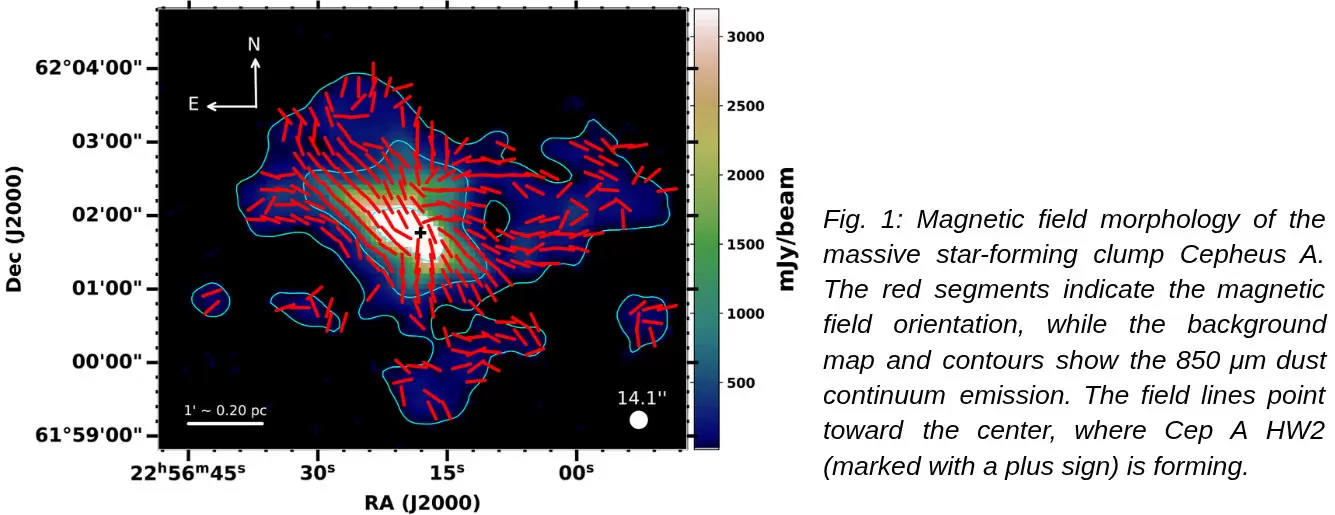
Evidence for the gravity-driven and magnetically regularized gas flows feeding the massive protostellar cluster in Cepheus A
This study, published in the journal Science Advances by Sandhyarani Panigrahy, Eswaraiah Chakali, and collaborators (2026), provides compelling evidence that magnetic fields and turbulence can work together with gravity to regulate the rapid accretion of gas required for the formation of massive stars in Cepheus A. The study further shows that gravity, magnetic fields, and turbulence are closely aligned with one another, with their energies following a clear hierarchy.
These findings challenge the conventional view that magnetic fields and turbulence primarily resist gravitational collapse at clump and hub scales. Instead, they appear to assist gravity by guiding and channeling material inward. In this picture, magnetic fields can be envisioned as channels directing water into a lake, efficiently funneling gas toward the central star-forming region.
The work is based on high-resolution and unprecedentedly sensitive dust polarization and molecular lines data acquired with the 15-meter submillimeter telescope known as James Clerk Maxwell Telescope (JCMT) using its instruments SCUBA-2/POL-2 and HARP.
(DOI: https://doi.org/10.1126/sciadv.ady2189)
|
|
|
|
|
|
(image credits: https://www.science.org/doi/10.1126/sciadv.ady2189)
Spliceosomes remove non-coding introns from precursor messenger RNA (pre-mRNA). They also perform alternative splicing of pre-mRNAs, producing multiple protein-coding mRNAs from a given gene. Alternative selection of competing 5' splice sites in introns is known to occur early in the splicing cycle by U1 snRNA and RNA-binding proteins. We studied the alternative splicing mechanism of yeast HEH1/SRC1 pre-mRNA, which harbours competing 5' splice sites. Surprisingly, early splicing factors were dispensable for this process. Instead, core spliceosomes containing U5 and U6 snRNAs selected and processed the closely-spaced 5' splice sites for alternative splicing.
A co-author, Balashankar R Pillai, was a BS-MS student.
Link for the paper: Click Here
Title: Algebra of the Yang–Baxter Equation: Skew Braces, Quandles, and Cohomology
Authors: Valeriy Georgievich Bardakov, Mohamed Elhamdadi and Mahender Singh
Publisher: Springer Nature
We are pleased to announce that Professor Mahender Singh has co-authored a new research monograph, accepted for publication in the prestigious Springer Monographs in Mathematics series. Co-authored with Valeriy Bardakov and Mohamed Elhamdadi, this volume represents a significant contribution to the field of modern mathematics. The work provides a systematic and comprehensive exploration of the algebraic structures—specifically skew braces, quandles, and cohomology—arising from the Yang–Baxter equation.
Originally rooted in the complexities of theoretical physics, including statistical mechanics and quantum theory, the Yang–Baxter equation has become a cornerstone of contemporary mathematical thought. It is expected to become an essential resource for researchers, advanced scholars, and graduate students working at the interface of algebra and mathematical physics.

This publication marks Professor Singh’s third major book with Springer Nature, following his previous research monograph and edited volume published in 2018 and 2019, respectively. This work underscores a continued commitment to global academic collaboration.
Link: View at Springer Nature
Image Credits: Springer Nature
The neuropathy-linked protein TECPR2 is a Rab5 effector that regulates cargo recycling from early endosomes
This study, published in Nature Communications (2025) by Sankalita Paul et al., identifies the cellular function of TECPR2 (Tectonin-β-propeller repeat containing protein 2), a protein whose mutation is linked to a form of Hereditary Sensory and Autonomic Neuropathy (HSAN), a severe neurodegenerative disorder.
This work provides a mechanistic understanding of how TECPR2 regulates the formation of specialized membrane subdomains that govern the fate of critical receptors, offering vital insights into the molecular etiology of HSAN.
(DOI: https://doi.org/10.1038/s41467-025-65568-4)

Figure: Summary of TECPR2 functional analyses in zebrafish.
A Yeast two-hybrid interaction of zebrafish Tecpr2 and the R1234W mutant with Rab5.
B Developmental expression profile of tecpr2 mRNA.
C In situ hybridization showing spatial tecpr2 expression during embryogenesis.
D, E Dose-dependent effects of tecpr2 morpholino on embryo survival (24 hpf) and hatching (72 hpf), with rescue by WT but not R1234W mRNA.
F Morphological defects in tecpr2 morphants and partial rescue outcomes.
G Representative NMJ staining in control, tecpr2 morphants, and rescue conditions.
H, I Quantification of α-BTX and SV2 areas from NMJ imaging.
Fungus-farming termites can protect their crop by confining weeds with fungistatic soil boluses
This study, published in Science (2025) by Aanchal Panchal et al., reveals the sophisticated pest management strategy employed by fungus-farming termites (Odontotermes obesus) to protect their vital fungal crop. It shows that termites actively combat invasive fungal weeds (Pseudoxylaria) by encasing them in specialized soil boluses containing fungistatic microbes. This research highlights a novel, highly targeted defense mechanism where insects integrate specific behaviors with microbial allies to selectively suppress fungal invaders without damaging their cultivated food source, offering key insights into co-evolutionary relationships and potential avenues for natural product discovery.
(DOI: https://doi.org/10.1126/science.adr2713)

Figure: O. obesus behavior in response to introduced Pseudoxylaria tuft on comb.
(A) Experimental setup: 20 major workers in an arena with 20 g of autoclaved, moistened soil containing two pieces of fresh fungus combs (FC). FC (left) is the control and FC+P (right) is the fresh comb with an introduced tuft of Pseudoxylaria. (B) (Left) Representative pictures of the different behaviors shown by termites (movies S1 to S3). Yellow arrows indicate the removed Pseudoxylaria hyphae. The bar charts (middle) represent the percentage of plates with the corresponding behavioral outcomes. The darker portions in the pie charts (right) denote the efficiency (in percentage) of each behavior in controlling Pseudoxylaria. (C) Area of comb scraped by the workers on FC versus FC+P (Wilcoxon-signed rank test, P < 0.001). (D) Efficiency of termites in controlling Pseudoxylaria compared with controls lacking termites. Lowercase letters (a, b, c, and d) denote significant statistical differences in a two-proportion Z test (table S1A). (Image Credits: https://www.science.org/ )
Decoding Organic Matter Sources in Himalayan Lakes Using Molecular Markers
This study, published in Ecological Indicators (2025) by Sunil Kumar et al., provides critical insights into the environmental health and ecological dynamics of Northwest Himalayan lakes. The research used lipid biomarkers—molecular fossils like n-alkanes and highly branched isoprenoids (HBIs)—in lake sediments to determine the origins and preservation of organic matter (OM).
This comparative analysis of Manasbal, Renuka, and Ahansar lakes highlights the utility of lipid biomarkers in tracing OM sources, which is essential for developing effective strategies for protecting these vital freshwater ecosystems under increasing anthropogenic and environmental pressures.
(DOI: https://doi.org/10.1016/j.ecolind.2025.113701)

Figure: Location map and bathymetry of the study area (Image corresponds to May 2023; Source: Google Earth). The locations of Ahansar Lake (AR) and Renuka Lake (RNK) discussed in the text are also shown (Image Credits: https://www.sciencedirect.com/ )
IISER Mohali, Knowledge city, Sector 81, SAS Nagar, Manauli PO 140306
Telefax : 2240266, 2240124
+91 - 172 - 2240266